2011-2017: Graduate school, University of Washington, Seattle
Advisor: Dr. Andres Barria
NMDA receptors (NMDARs) are essential molecules for learning and memory.
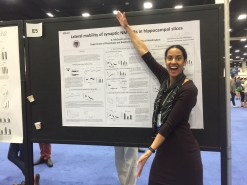
They serve as coincidence detectors: If two neurons are active at the same time, the NMDARs kindly point it out by sending the second messenger calcium cascading into the cell. What results from this NMDAR-derived messenger is that the neurons can connect through that amazing process of synaptic plasticity. This process is the basis of learning all new information, whether it be factual or motor based.
My PhD centered on how neurons regulate these receptors. After all, you probably don’t want your neurons to change for every stimulus you encounter in the world, just the really important ones. There are many ways neurons can adjust how sensitive they are to change, one of those ways being the number of NMDARs located within synapses. My research outlined two different pathways by which neurons can regulate NMDAR synaptic content: The first pathway involved a secreted glycoprotein, which could release calcium from the internal stores of neurons and promote NMDAR trafficking to the surface. This is where I grew fascinated by how intracellular organelles could influence the physiology of electrically excitable cells, which carried over into my postdoc research. The second pathway showed that NMDARs can actually rapidly diffuse on the surface of neurons into and out of synapses in a manner dependent on neuronal activity. These are hardly the only two ways neurons regulate NMDAR content, but I was the first to detail both of them, especially in hippocampal slices.
Skills acquired include patch clamp electrophysiology, cultured hippocampal slice preparation, isolated hippocampal neuron culture preparation, calcium imaging, live cell confocal microscopy, and two-photon microscopy.
Publications
A McQuate and A Barria. (2020) Rapid exchange of synaptic and extrasynaptic NMDA receptors in hippocampal CA1 neurons. Journal of Neurophysiology https://doi.org/10.1152/jn.00458.2019
https://journals.physiology.org/doi/full/10.1152/jn.00458.2019
A McQuate, E Latorre-Esteves, and A Barria. (2017) A Wnt/calcium signaling cascade regulates neuronal excitability and trafficking of NMDARs. Cell Reports S2211-1247(17)31298-6.
https://www.cell.com/cell-reports/comments/S2211-1247(17)31298-6
Awards
Society for Neuroscience Trainee Professional Development Award
National Science Foundation (NSF) Graduate Research Fellowship
Neurobiology Training Grant
Achievement Rewards for College Scientists (ARCS) Fellowship
 Andrea L McQuate