2017-present: Postdoctoral fellow, University of Washington, Seattle
Advisor: Dr. David Raible
As all my research training at this point had been in hippocampus, with an emphasis on electrophysiology, I changed fields for my postdoc to gain experience in genetics and microscopy, and rapidly morphed from a synaptic physiologist to mitochondrial biologist. Whoa, 180 degree change!
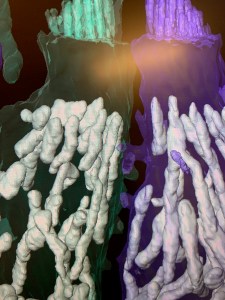
Mitochondria have been long implicated in both hereditary and environmentally induced hearing loss, and it doesn’t take too much work to see why. The hair cells in our inner ear, which are responsible for converting mechanosensory stimuli into the sounds we hear, are constantly active, demanding their mitochondria to keep up with this high metabolic demand. Thus, it is not surprising that slight alterations in mitochondrial function can result in hearing loss. But we don’t know the precise relationship between hair cells and their mitochondria to be able to interfere when things are awry. Using the hair cells of the zebrafish lateral line as a model for hair cells in the inner ear, I now currently study the roles of mitochondria dynamics, mitochondria-endoplasmic reticulum interactions, mitochondrial morphology, and intracellular store calcium handling in hair cells, with the goal of identifying factors that may lead to hair cell sensitivity, damage, and deafness. My most recent project includes using serial block face scanning electron microscopy to create three-dimensional representations of hair cell mitochondria with electron level resolution. I have currently found that hair cells have a mitochondrial phenotype that is perhaps best suited for their physiology. This work joins a body of research showing the cell-specificity of mitochondria, and how they are fine-tuned to their cellular environment. By understanding how mitochondria are tailored within hair cells provides an opportunity to develop mitochondrially targeted therapeutics for hearing loss disorders.
Publications:
McQuate A, Knecht S, Raible D. Activity regulates a cell type-specific mitochondrial phenotype in zebrafish lateral line hair cells. https://www.biorxiv.org/content/10.1101/2022.06.17.496604v1. Re-submitted to Elife.
McQuate A, Raible D. Finding the balance: the elusive mechanisms underlying auditory hair cell mitochondrial biogenesis and mitophagy. Hearing Research 2023 https://pubmed.ncbi.nlm.nih.gov/36566644/
With many, many more experiments yet untapped!
Awards:
CPI Recognition of Professionalism
Association for Research in Otolaryngology MidWinter Meeting Travel Award
(F32) Ruth L. Kirschstein National Research Service Award (NIDCD)
Selected as an NIH Future Research Leader
 Andrea L McQuate